Since July 1, 2024, almost every employer in California has needed a written Workplace Violence Prevention Plan, yearly employee training, and a violent incident log. We write the plan, walk your site, train your people, set up your log, and come back every year to keep it current.
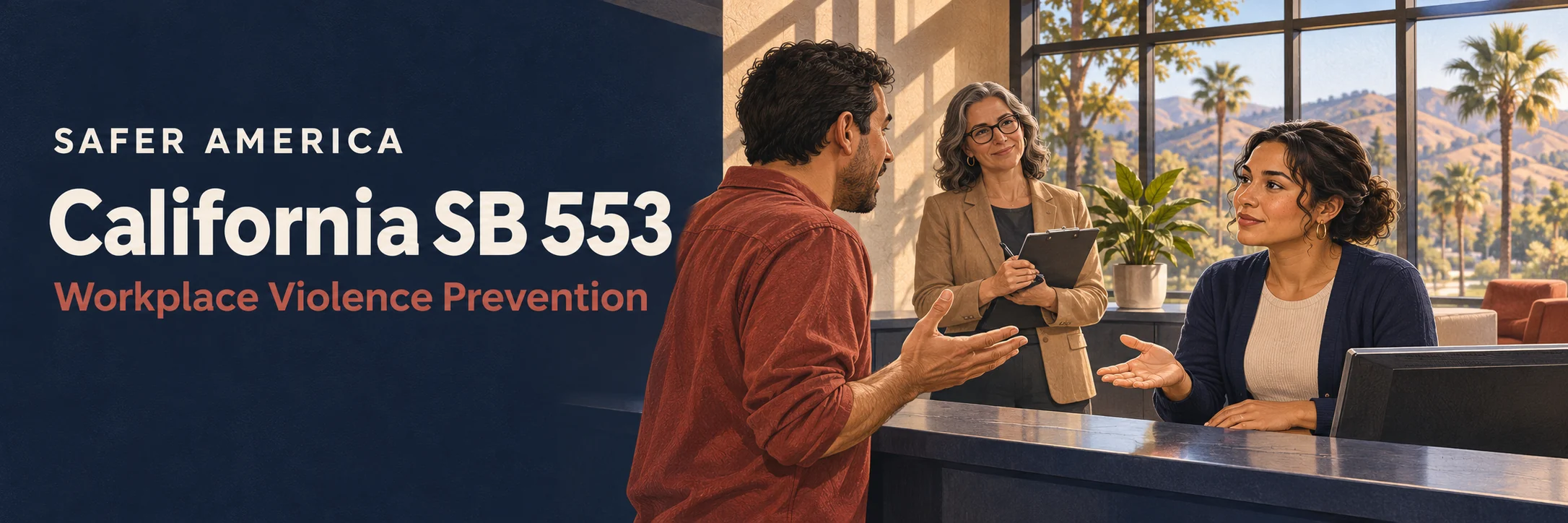
A visitor walks up to your front desk upset, raising their voice and demanding to see a manager. Your receptionist is the only one there. Walk through it with your team:
If your team gave three different answers, that is what training is for. We practice moments like this live, in person or by video.
Ask QuestionsCal/OSHA's Standards Board has until December 31, 2026 to adopt a permanent workplace violence prevention standard for general industry. The draft goes further than today's law: more required hazard inspections, more records kept for five years, and coverage for employer-provided transportation.
The final text is not adopted yet, and today's law is what applies until it is. We build your plan to today's law, follow the rulemaking, and bring your plan in line with the final version at your annual review.
SB 553 covers nearly every employer in California, in every industry. The exceptions are narrow, and a small business is usually not one of them.
Not sure where you fall? Call (310) 422-6172. If you're exempt, we'll tell you on the first call.
Cal/OSHA has been enforcing these since July 1, 2024. A plan sitting in a drawer that nobody has been trained on does not meet them.
In writing, available to employees at all times, and in effect in every work area. It can be its own document or a standalone section of your Injury and Illness Prevention Program (IIPP).
When the plan starts, every year after, and again when a new hazard turns up or the plan changes. It has to be in language your employees understand, with a live chance to ask questions of someone who knows your plan.
Every incident gets logged, injury or not, with no names or personal identifying details. Each entry records the date, time and place, the type of violence, what happened, who was involved by category, the circumstances, and what was done about it.
Hazard records, incident logs and investigation records: kept at least five years. Training records (dates, content, trainer names and qualifications, attendees): at least one year. Employees can ask for copies free of charge, and you have 15 calendar days to provide them.
You shouldn't need a consultant for the plan, a different vendor for the training, and a spreadsheet nobody owns for the log. We do all of it, and we come back.
Drafted around your actual workplace and people, not a fill-in-the-blank template. Every required element, the names and roles you choose, written so your employees can actually read it.
An on-site visit to find and evaluate hazards: entrances, working alone, late shifts, cash handling, poorly lit areas, and how help would really get called. Written up so the findings and fixes are on record.
The required initial and annual training, taught live by a qualified instructor, in person or by live video, with real time for questions. It covers everything the law lists.
The law expects employees to have a real part in building and reviewing the plan. We run that input for you and document it.
A violent incident log set up the way the law describes it, plus a simple system for training and hazard records, so you can produce them within 15 days when someone asks.
Every year we review the plan, the log and any incidents, update what needs updating, and run the annual training. When Cal/OSHA's final standard is adopted, this is where your plan catches up.
Our training was written by our founder, Chuck Heacock, over thirty years of building safety programs for ordinary people: how to read someone winding up, stay level, make space, and get out. Qualified instructors teach it, the same way in every workplace.
Price depends on how many locations you have, how many employees need training, and whether training is in person or by video. Nothing is priced before we know your workplace.
Not necessarily a separate document. The law lets your workplace violence plan be its own document or a standalone section inside your IIPP. What it can't be is a sentence or two added to the IIPP. It has to contain every required element and be in effect in every work area.
The law requires a live chance for employees to ask questions of someone who knows your plan. A recorded video on its own doesn't meet that. We teach the training live, either in person or by video call, with real time for questions.
Employees teleworking from a place they choose, outside your control, are excluded. Anyone who works at a location you control, even part of the week, is covered.
Only if both of these are true: fewer than 10 employees are on site at any time, and the workplace is not open to the public. A five-person shop with a front counter is covered. If you are exempt, we'll tell you so on the first call.
The plan has to address the hazards of each work area and operation, so every site gets looked at. We can cover all of your California locations under one coordinated plan, with each site's hazards written in.
The people responsible for carrying it out, by name or job title. You choose them. We write each role clearly so nobody is guessing who does what when something happens.
We draft it around your workplace and your people, and you review and adopt it. It is your plan and your company stays responsible for following it. We make sure it says what the law requires and that your people actually know it.
That is the deadline for Cal/OSHA's Standards Board to adopt a permanent workplace violence prevention standard for general industry. The draft adds requirements beyond today's law. Until the final rule is adopted, today's law is what applies. When it is adopted, your annual review is where we bring your plan in line with it.
No. SB 553 is a California law. Outside California, organizations book the same written plan, walkthrough and training because it is a smart thing to have, not because a state requires it.
This page summarizes California Labor Code section 6401.9 (SB 553) as of October 2026. It is general information, not legal advice. For your specific situation, check the current law and Cal/OSHA's workplace violence guidance, or ask your attorney.
Tell us about your workplace and a real person calls you back within one business day. No cost and no obligation for the first conversation.
Questions about keeping your people safe?
Pick a topic and get a straight answer in seconds.